
7 Steps to Publishing in a Scientific Journal
This article discusses 7 basic steps to publishing in a scientific journal. To give you an opportunity to practice proofreading, we have left a few spelling, punctuation, or grammatical errors in the text. See if you can spot them! If you spot the errors correctly, you will be entitled to a 10% discount.
Writing and publishing a scientific research paper require more than just bookish knowledge. Every year, thousands of scientists and researchers strive to publish their research papers in suitable journals, but many of them fail without following proper guidelines. As a professional proofreading and editing service, we often find that many aspiring scientists rush to publish their research but ultimately face rejection.
According to Springer, approximately 80% of the proposed articles or manuscripts face rejection at the time of screening. That means only 20% of scientific articles get approval. Being a trusted proofreading and editing expert, we can feel the depth of mental agony a researcher experiences after the rejection. In this quick guide, intended for graduate students and other young scholars, we identify 7 common pitfalls and offer helpful solutions to prepare more impactful papers.
1. Choose the topic wisely
Choosing a topic strategically is the initial as well as the most important step of preparing a scientific manuscript efficiently. While choosing the topic for the manuscript, make sure that the topic is logical and argumentative. Don’t choose a topic that is very common and was discussed many times in the past. Most importantly, restrain yourself from choosing any topic that doesn’t interest you. You may consider the following tips to select a good topic.
-
Be specific about the research
-
Start brainstorming.
-
Select the topic and give it a form of a question.
-
Create an outline for research
2. Identify a suitable journal for publishing your research
Choosing a topic is useless if you can’t find a trusted journal to publish your research. Here, you need to go through extensive research to trace a journal to publish your research. You may seek advice from your fellow researchers and senior authors. You may refer to Elsevier Journals, Web of Science, and other publishing outlets.
3. Prepare the manuscript efficiently
Writing the manuscript efficiently is the most crucial part. If you commit any error in this part, the manuscript will get rejected for sure. Generally, a scientific research paper follows this basic structure.
-
Mention all the used references and complete in-texting.
-
Conclude your research.
-
Discuss the result and elaborate on the data.
-
Mention applied methodology as well as materials in this part.
-
Write attractive information.
-
Write a logical and informative abstract.
-
Use an appropriate title.
4. Avoid plagiarism and falsification
While writing, restrain yourself from mentioning any false statement and make your research paper free from plagiarism. If you copy or paraphrase from another research paper, there is a high chance that your paper will trace plagiarism. However, having caught plagiarism can have the worst impact on your career and lead to several legal issues.
We often find that some researchers use false or imaginary statements to skip plagiarism. However, it can weaken the plot of your research and lead your research paper to rejection.
5. Send an impressive cover letter to the editor
It is an essential but an ignored part of the process of article publication. You should send an impressive cover letter to the editor about the outline and purpose of your research. If you can convince the editor with your manuscript, the editor sends the manuscript for review. Two or more reviewers will review your manuscript. During the process, they contact you to inform you about the status of your manuscript.
6. Consult an expert for proofreading and editing
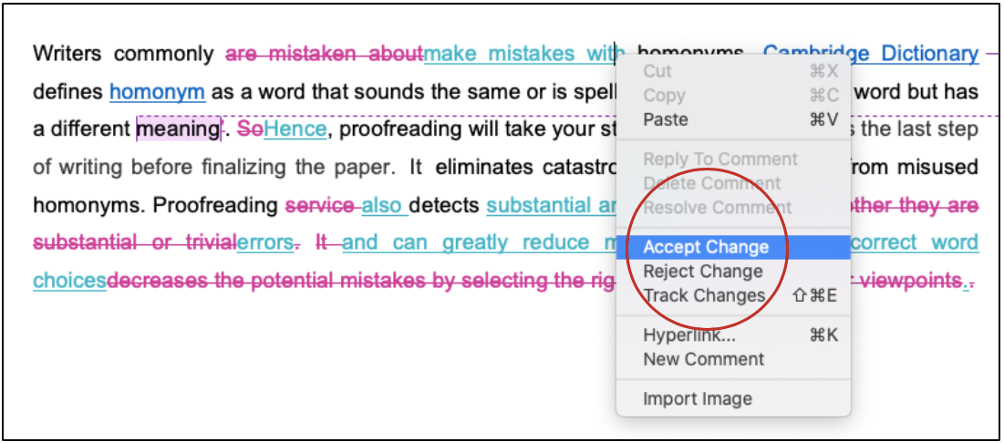
As per the report of Elsevier, approximately 30% to 50% of articles face rejection due to poor use of the English language and inappropriate review. Another study by NCBI revealed that about 20-30% of the manuscripts can be very quickly categorized as unsuitable or beyond the scope of the journal. We notice that some researchers ignore the review part and ultimately get rejected. Here, they can consult an experienced proofreader and editor to get their manuscript reviewed. An initially written manuscript generally encounters many issues related to grammar, syntax, choosing words, and sentence structure, etc. An experienced proofreader and editor review your entire manuscript and makes required changes to make the article more informative and error-free.
7. Check the reviewers’ comments very carefully
If the status of your submission is “revise & resubmit,” it is time for you to check all the comments very carefully and address all the necessary changes positively. While revising your manuscript, you need to remember that you have to resubmit the revised manuscript within the given deadline. However, the entire process of revision and resubmitting demands the following two documents:
-
Updated manuscript as per the instruction of reviewers
-
A letter to the editor addressing the changes made in the manuscript.
You need to draft these two documents very carefully. For the best result, you may consult an experienced proofreading and editing service to address the comments of the reviewers more efficiently. You may also find the following articles helpful:
Conclusion
Publication of an article in an appropriate journal is a milestone in your academic career. However, if you have already completed your manuscript, you can contact the ‘Best Edit & Proof’ to review your article and make necessary changes associated with grammar, tone, sentence construction, and use of language. You may contact our experts for more information.
If you need us to make your manuscript shine, contact us unhesitatingly!
Best Edit & Proof expert editors and proofreaders focus on offering manuscripts with proper tone, content, and style of academic writing, and also provide an upscale editing and proofreading service for you. If you consider our pieces of advice, you will witness a notable increase in the chance for your research manuscript to be accepted by the publishers. We work together as an academic writing style guide by bestowing subject-area editing and proofreading around several categorized writing styles. With the group of our expert editors, you will always find us all set to help you identify the tone and style that your manuscript needs to get a nod from the publishers.
English manuscript formatting service
You can also avail of our assistance if you are looking for editors who can format your manuscript, or just check on the particular styles for the formatting task as per the guidelines provided to you, e.g., APA, MLA, or Chicago/Turabian styles. Best Edit & Proof editors and proofreaders provide all sorts of academic writing help, including editing and proofreading services, using our user-friendly website, and a streamlined ordering process.
Get a free quote for editing and proofreading now!
Visit our order page if you want our subject-area editors or language experts to work on your manuscript to improve its tone and style and give it a perfect academic tone and style through proper editing and proofreading. The process of submitting a paper is very easy and quick. Click here to find out how it works.
Our pricing is based on the type of service you avail of here, be it editing or proofreading. We charge on the basis of the word count of your manuscript that you submit for editing and proofreading and the turnaround time it takes to get it done. If you want to get an instant price quote for your project, copy and paste your document or enter your word count into our pricing calculator.

24/7 customer support | Live support
Contact us to get support with academic editing and proofreading. We have a 24/7 active live chat mode to offer you direct support along with qualified editors to refine and furbish your manuscript.

Stay tuned for updated information about editing and proofreading services!
Follow us on Twitter, LinkedIn, Facebook, Instagram, and Medium.
For more posts, click here.
Categories
- APA Style
- Editing & Proofreading
- Citation Styles
- Grammar Rules
- Academic Writing
- Formatting
- Plagiarism
- Editing
- Proofreading
- Microsoft Tools
- Academic Publishing
- MLA Style
- Dissertation & Thesis
- Researching
- Job & Research Application
- Statistics
- Academic Tools & Resources
Similar Posts
-
How to Determine Variability in a Dataset
14.10.2023
-
How to Determine Central Tendency
19.02.2023
-
How to Specify Study Variables in Research Papers?
14.01.2023
-
Population vs Sample | Sampling Methods for a Dissertation
14.01.2023
-
How to Ensure the Quality of Academic Writing in a Thesis and Dissertation?
04.12.2022
-
How to Avoid Anthropomorphism in Your Dissertation?
04.11.2022
-
How to Write a Research Paper After Finishing a Dissertation or a Thesis
28.08.2022
-
How to Write a Research Methodology Section for a Dissertation and Thesis
07.08.2022
-
How to Write a Theoretical Framework for a Dissertation and Thesis?
05.08.2022
-
How to Write Literature Review for a Dissertation and Thesis
02.08.2022
Recent Posts
-
How to Write an Abstract for a Qualitative Research Paper
18.05.2026
-
Abstract Keywords: How to Choose Them for Maximum Discoverability
18.05.2026
-
How to Write a Cover Letter for Journal Submission
18.05.2026
-
Cover Letter Mistakes to Avoid in Academic Applications
18.05.2026
-
Writing an Abstract in English as a Non-Native Speaker
15.05.2026
They Also Read

June 10, 2021
Submitting a journal article can be a nerve-wracking experience. After all, this piece of work requires hours of research, analysis, and work poured into it. Therefore, you would wish for it to be acknowledged, selected, and published. This guide will give you some crucial answers, so go ahead and take a read. This way, you can ensure that your journal submission is devoid of any hassle.
Continue Reading
June 10, 2021
After writing your manuscript, you may likely decide on an editor to perform the final checks on your document. Mostly, authors make the mistake of sending their manuscripts to their editors, without providing adequate information about specifications on the service they seek. With such limited information, your editor may produce an unsatisfactory job with limited information at his/her disposal. Thus, to ensure that your editors provide the best possible service, which will prevent journals from rejecting your manuscripts on the grounds of noncompliance to journal requirements, the following information should be provided beforehand.
Continue Reading
June 10, 2021
Some essays use logical and factual data to sustain their claims. They are known as argumentative essays and form a significant proportion of all essays written by scholars and students during their academic tenure. This article demonstrates how to write an argumentative essay by dividing the writing process into four detailed steps. Hence, readers looking to augment the plausibility of their argumentative texts should ensure to abide by them.
Continue Reading
June 10, 2021
The cover letter acts as the first impression that the authors or their work will have on the editor. It can be contemplated as the “sales pitch” of the conducted research and the submitted work. It, therefore, deserves meticulous attention and should never be written half-heartedly. This article discusses how to write a persuasive cover letter for journal submission and presents an easy-to-follow rubric that will help you draft an impeccable cover letter.
Continue Reading
June 10, 2021
Formal writing can cover everything from academic essays to a thesis or dissertation; a few fundamental rules are valid in all types of academic writing. A student can find writing in different formats boring or unbearable. With the following tips, you will start finding academic writing almost enjoyable and utterly rewarding.
Continue Reading